

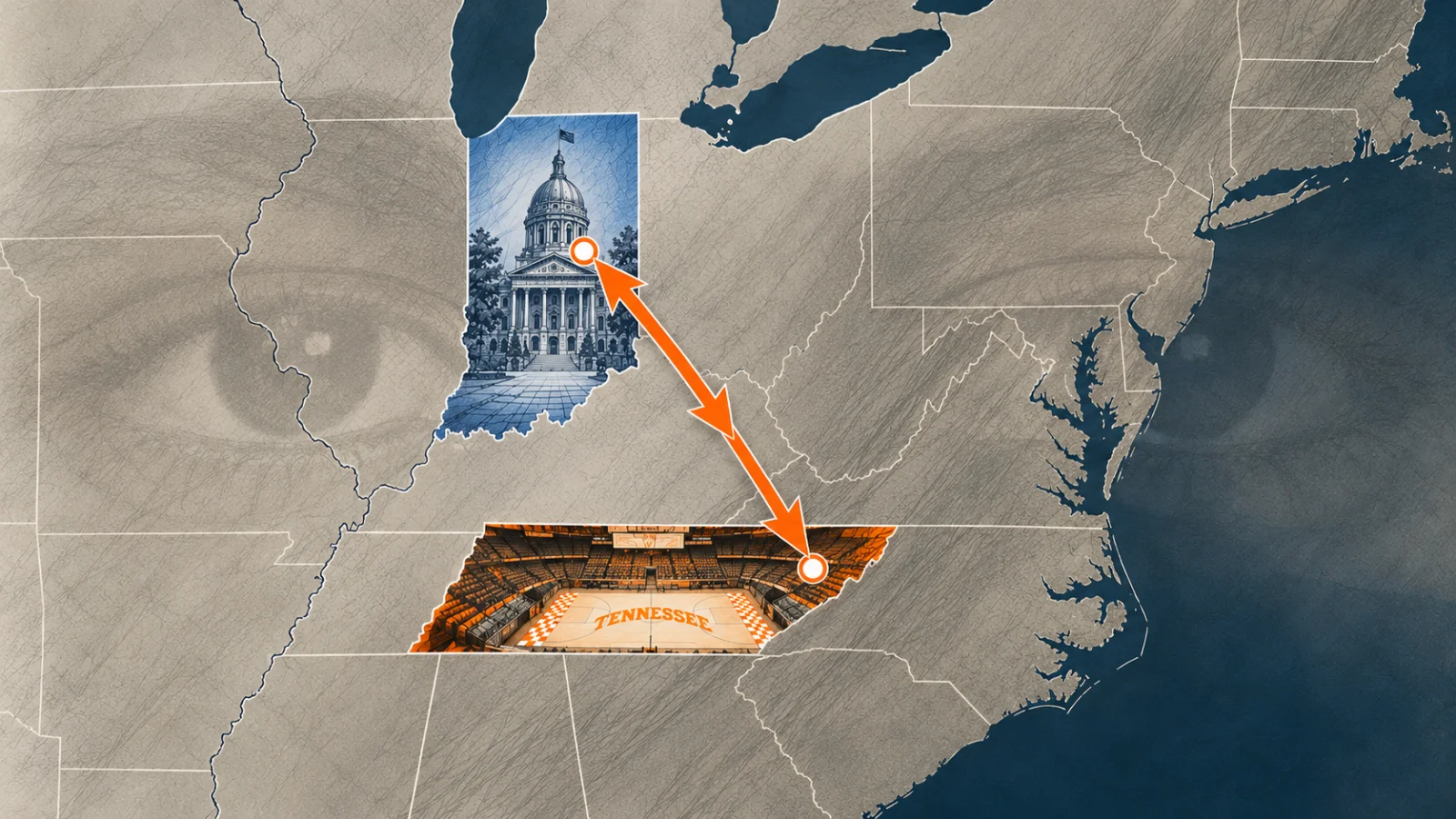
After another setback in Tennessee, Jalen Washington has reason to examine the legal path that restored eligibility for three other athletes—including a former plaintiff in his own lawsuit.
Jalen Washington’s eligibility fight has reached a frustrating crossroads. But while Tennessee’s courts have repeatedly frustrated his efforts to play for the Volunteers, a different story is unfolding several hundred miles north.
In Indiana, athletes facing essentially the same NCAA restrictions have found a way back onto the court.
And Washington might have good reason to follow them.
The latest setback came October 16, when the Tennessee Supreme Court declined to intervene in the suspension of an injunction that had temporarily protected Washington’s eligibility.
For the 6-foot-10 forward, it was another discouraging development in a legal battle that began before he arrived in Knoxville.
But it wasn’t necessarily the end of the road.
The Indiana precedent
Perhaps the most compelling example is Indiana basketball forward Sam Alexis.
Alexis was among the plaintiffs in Washington’s original Tennessee lawsuit. Like Washington, he initially benefited from an injunction that allowed athletes from the high school class of 2022 to pursue another season of competition.
When Tennessee’s appellate court stayed that injunction in August, both players lost their protection.
But their paths subsequently diverged.
Alexis joined a separate Indiana lawsuit challenging the NCAA’s eligibility restrictions. On September 23, Monroe County Circuit Court Judge Kara Krothe granted a preliminary injunction covering 97 athletes, including Alexis.
Suddenly, Alexis was eligible again.
And his wasn’t an isolated case.
Indiana football defensive linemen Stephen Daley and Kellan Wyatt had previously received eligibility protection through a federal lawsuit in Colorado. When an appellate court suspended that ruling, their eligibility disappeared.
Rather than accept that outcome, they pursued relief in Indiana.
They obtained a temporary restraining order in early September, briefly lost eligibility when that order expired, and then regained protection under the same September 23 injunction that benefited Alexis.
Three athletes. Two unsuccessful legal detours. One Indiana courtroom offering another opportunity.
Then came October 16.
While Washington was receiving disappointing news from Tennessee’s highest court, the Indiana Court of Appeals denied the NCAA’s emergency request to suspend the injunction protecting Alexis, Daley, Wyatt and their fellow plaintiffs.
The underlying Indiana lawsuit remains unresolved. But for now, those athletes can compete.
That’s a distinction Washington and his attorneys surely cannot overlook.
Why Indiana might make sense
Washington has another connection worth considering: he’s an Indiana native.
The Gary product starred at West Side Leadership Academy before beginning his college career at North Carolina.
The NCAA, meanwhile, maintains its headquarters in Indianapolis.
Neither fact automatically establishes that Washington can successfully bring another case in Indiana. His attorneys would need to address jurisdiction, his existing litigation and whether he could join the current lawsuit or pursue separate relief.
But Indiana’s courts have already considered the central eligibility dispute—and granted meaningful protection to athletes who previously lost it elsewhere.
The underlying argument isn’t particularly complicated.
The NCAA adopted a new five-season eligibility model this summer, but excluded athletes who had already completed four seasons after entering college in 2022.
Those athletes contend the change unfairly denies them the same opportunity being extended to others.
In granting relief, the Indiana court found sufficient grounds to protect the plaintiffs while their challenge proceeds, including concerns about the NCAA’s earlier representations concerning future eligibility rules.
The NCAA disputes those claims and continues fighting the injunction.
Washington would also need his own enforceable protection. An injunction covering other athletes doesn’t automatically make him eligible, and Tennessee would understandably want assurance against potential NCAA penalties before putting him on the floor.
Those are serious legal considerations—not reasons to dismiss the possibility.
Xavier offered a timely reminder
Tennessee’s 86-70 exhibition loss to Xavier on October 15 added another dimension to Washington’s absence.
The Volunteers were outrebounded 45-31, surrendered 17 second-chance points and watched Xavier score 59 second-half points. Particularly troubling was the 24-10 rebounding deficit after halftime.
Those numbers exposed weaknesses in Tennessee’s physicality, defensive execution and frontcourt depth—precisely the areas where an experienced 6-foot-10 forward could provide valuable help.
Washington wouldn’t have single-handedly prevented the Vols’ second-half collapse. And exhibition games aren’t necessarily reliable predictors of an entire season.
But the performance offered a sobering reminder: Tennessee could use every capable, experienced player available.
Washington isn’t simply fighting for another year of basketball. He’s fighting for an opportunity to help a team that may genuinely need him.
The clock is ticking
Rick Barnes has publicly expressed frustration with the unequal outcomes emerging from these eligibility disputes. He’s made clear that he believes Washington deserves the opportunity to play.
And it’s difficult to disagree with the underlying concern.
How can one athlete remain eligible in Indiana while another, facing a similar dispute, remains sidelined in Tennessee?
Different courts can reach different conclusions. That’s how litigation works.
But athletes have limited seasons, limited opportunities and limited time to wait for the legal system to sort everything out.
Washington has already spent months navigating that uncertainty.
An Indiana filing would carry no guarantee of success. It could introduce additional complications, and only his attorneys can determine whether the legal path is genuinely available.
Nevertheless, Alexis, Daley and Wyatt have demonstrated something important: losing eligibility protection in one jurisdiction does not necessarily mean every avenue has been exhausted.
For Washington, Indiana deserves more than a passing glance.
With the regular season approaching, the question isn’t simply whether another legal challenge might succeed.
It’s whether Washington can afford not to explore one.
– Vol Hoops Staff Writer