

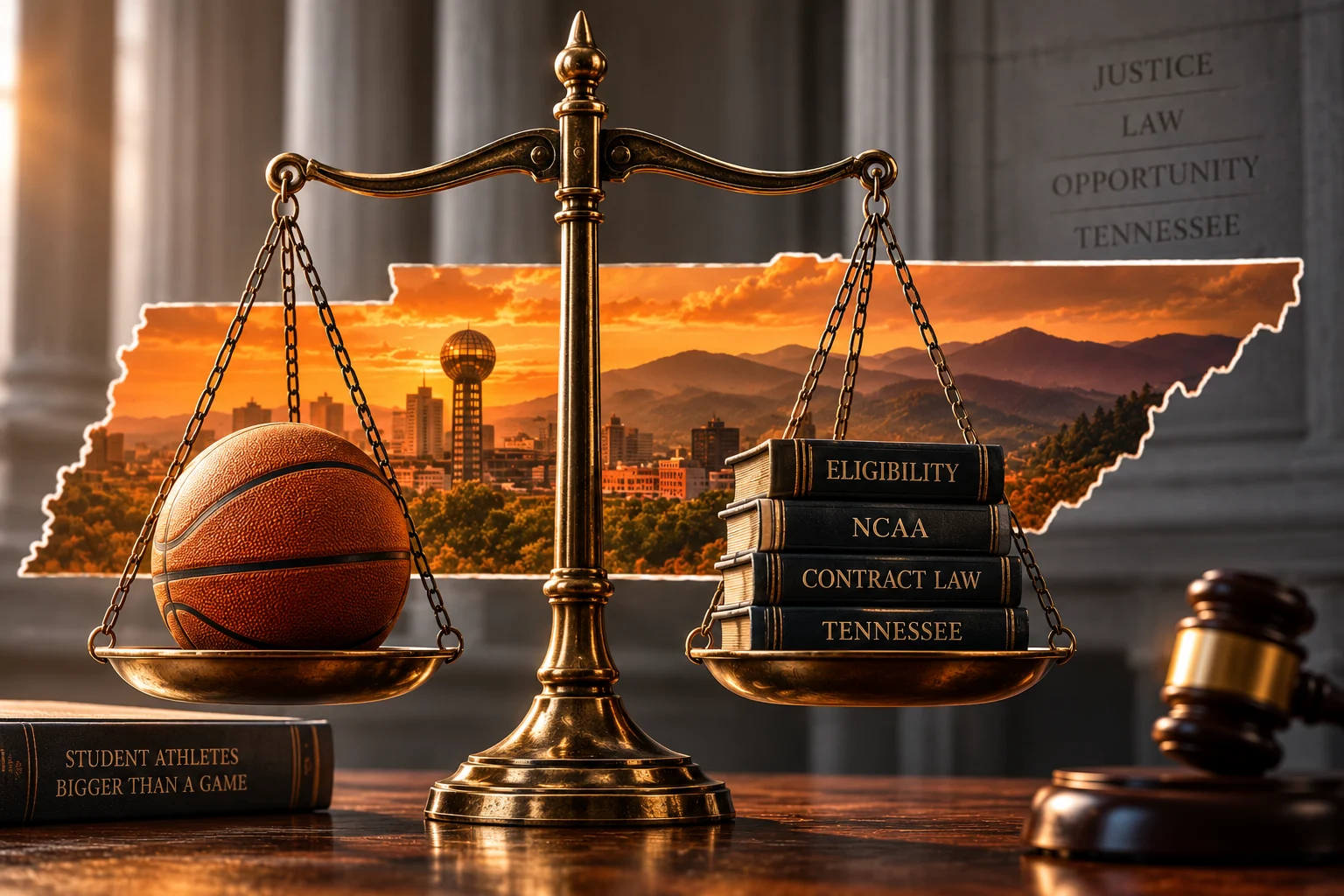
Let’s get one thing out of the way: Vol Hoops does not employ a constitutional-law department.
But we do have Google, coffee and a rather significant interest in whether Jalen Washington gets to play basketball for Tennessee this season.
So let’s scout this thing.
Washington and 18 other players won Round One on July 31, when Davidson County Chancellor I’Ashea Myles temporarily blocked the NCAA from denying them a fifth season. Her reasoning included something ordinary people can understand: the NCAA had handed extra eligibility to some groups of athletes while refusing comparable treatment to these players.
Washington promptly signed with Tennessee. Rick Barnes described him as an experienced low-post presence who can score inside and stretch the floor. In other words, this isn’t some theoretical legal exercise for the Vols. There’s a useful basketball player attached to it.
Then came Round Two.
That’s where Vol fans should get nervous
On August 26, the Tennessee Court of Appeals stopped the injunction while it considers the NCAA’s appeal. More troubling for Washington, the court specifically pointed to the NCAA’s “likelihood of success on the merits.”
Translated from Lawyer into Sports Guy: the appeals court didn’t just stop the clock. It told us which team it currently thinks has the stronger hand.
That’s the single biggest reason I’m not wearing orange-colored glasses here.
But Washington has something going for him, too.
His argument isn’t simply, Hey, this isn’t fair.
Tennessee courts recognize that contracts carry an expectation of good faith and fair dealing. The state’s Supreme Court has previously enforced that principle, including unanimously reviving a claim where one party allegedly exercised contractual power unreasonably. Different case, very different facts—but Washington’s basic legal theory isn’t something his lawyers invented on a cocktail napkin.
And just yesterday, another group of athletes fighting the NCAA’s treatment of the 2022 class won a preliminary injunction in Arkansas. That doesn’t control what Tennessee courts do, but it does tell us Washington’s side isn’t alone in persuading judges that there’s a legitimate problem here.
Okay, so who’s waiting upstairs?
One important technicality: Washington’s case isn’t at the Tennessee Supreme Court yet. It’s presently before the Court of Appeals. We’re speculating about what happens if the fight eventually reaches Tennessee’s highest court.
And the current five are Chief Justice Jeffrey Bivins and Justices Sarah Campbell, Dwight Tarwater, Mary Wagner and Kyle Hixson, who was appointed to replace the retired Holly Kirby this year.
There are some fun Rocky Top connections. Campbell is a UT graduate and former student-body president. Tarwater grew up in Knoxville and earned both his undergraduate and law degrees at Tennessee. Hixson also earned both degrees at UT.
Does that mean anything?
Probably about as much as checking which referee ate breakfast in Knoxville.
These people aren’t deciding whether they like Tennessee. They’re deciding whether the NCAA was legally entitled to apply its eligibility rules the way it did.
What interests me more is that this doesn’t look like a court that needs to invent some revolutionary new doctrine for Washington to win. Tennessee already recognizes the good-faith principle his side is leaning on. The question is whether it actually applies strongly enough here to overcome the NCAA’s authority to administer its eligibility rules.
So who has the lead?
If this were a basketball game, I’d have the NCAA ahead at halftime.
Washington won the opening quarter. The NCAA won the second—and the language used by the Court of Appeals was considerably more ominous than simply saying, We’ll sort this out later.
Still, there’s a lot of basketball left. Washington has already convinced one Tennessee judge. Similar athletes are winning arguments elsewhere. And there’s an awkward common-sense question sitting underneath the whole dispute: if the NCAA decided five seasons in five years is an acceptable model going forward, how convincing is its explanation for drawing the transition line where it did?
That’s the argument I’d want if I were Washington.
The appeals court’s early assessment is the argument I’d want if I were the NCAA.
The Vol Hoops call
Put all of it together and I’d currently lean NCAA—but not by much.
If this case ultimately reaches the Tennessee Supreme Court in substantially its present form, our read is that Washington has a real path to winning, but he’d be arriving there after an intermediate appellate court has already publicly questioned the strength of his case.
That’s a deficit. It isn’t a knockout.
And if we’re doing exactly what the headline promised—speculating—Vol Hoops would put Washington’s chances of ultimately getting the favorable Tennessee-court outcome he needs at about 40%.
Not great. Not dead.
But certainly worth keeping the jersey handy.
– Vol Hoops Staff Writer