

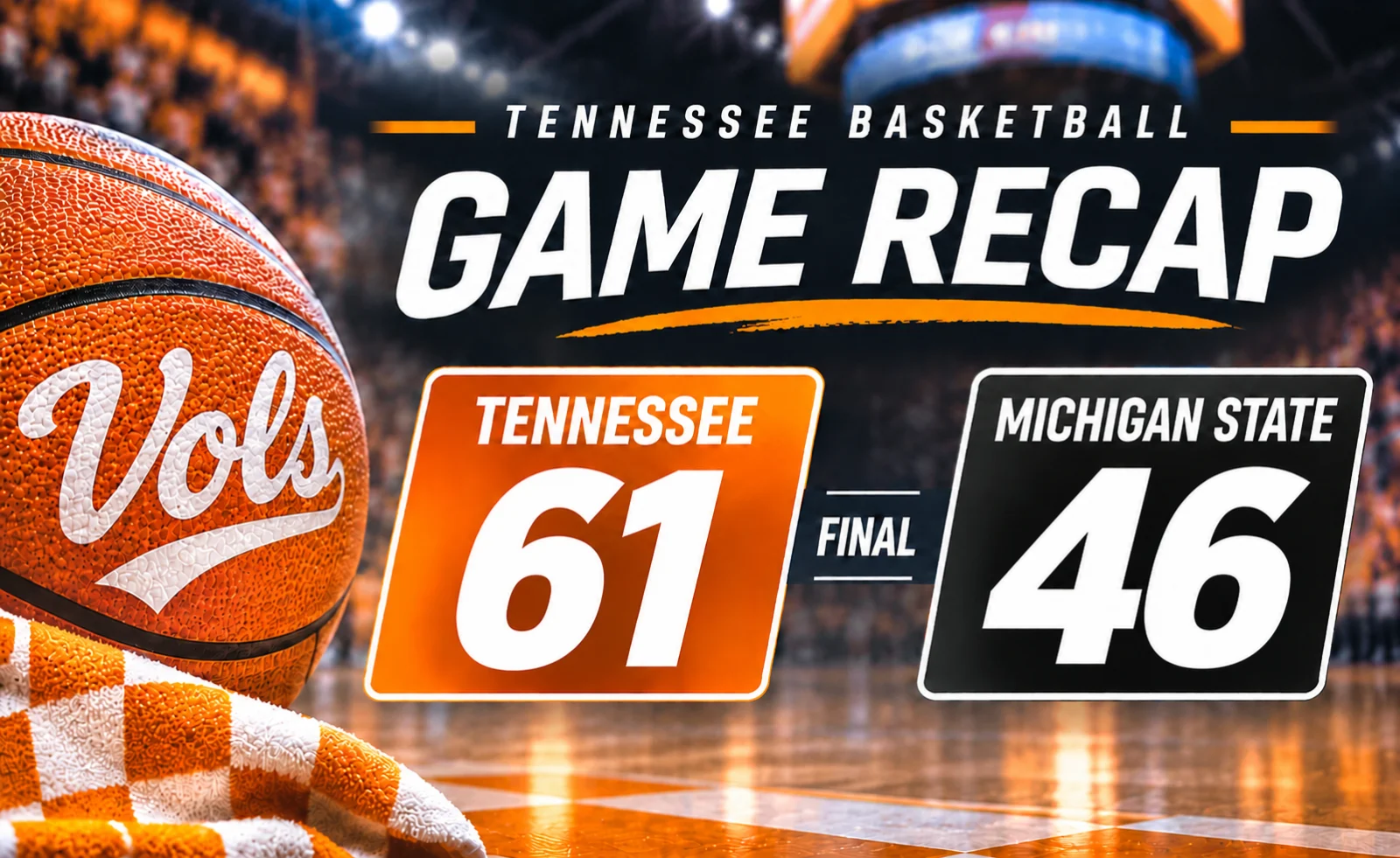
For three games, Tennessee had been searching for itself. Tuesday night, against the No. 2 team in America, the Volunteers found something worth building on.
No. 14 Tennessee stunned Michigan State 61–46 before a sold-out Food City Center crowd, delivering a defensive performance so extraordinary that the final score hardly tells the story.
Nine field goals. Forty minutes.
That’s all the Spartans could manage.
Michigan State shot an astonishing 18% from the floor, making just nine of 50 attempts. It was the first time since 1949 that an AP Top 20 team had failed to make at least 10 field goals in a game.
But beyond the historic numbers, something potentially more important happened in Knoxville.
A Tennessee team still learning how to play together began discovering who it might become.
A Defense Finds Its Identity
The evening didn’t begin like a masterpiece.
Michigan State built an early 10-point advantage, threatening to expose the same inconsistencies that had frustrated Rick Barnes through Tennessee’s first three victories.
Then the Vols found their footing.
An 11–0 first-half run helped Tennessee take a 27–25 halftime lead. The Volunteers followed with 12 unanswered points to open the second half, turning a close contest into a commanding advantage.
Michigan State went nearly 10 consecutive minutes without a field goal.
The Spartans managed just three baskets after halftime, shooting 3-of-26 over the final 20 minutes.
Barnes offered a straightforward explanation afterward.
“We closed down the lane as much as we could and hoped they didn’t make the (3-pointers),” he said. “Championship teams defend and rebound. It’s just a mindset.”
That mindset, more than any individual performance, may have been Tuesday’s most encouraging development.
Brown and Rubin Set the Tone
DeWayne Brown II and Miles Rubin led Tennessee with 14 points apiece, giving the Vols a formidable interior presence against Michigan State’s physical frontcourt.
Brown added seven rebounds and three assists, while Rubin contributed eight rebounds and three blocked shots.
Together, they helped Tennessee establish the kind of defensive resistance and physicality that has long defined Barnes’ best teams.
Michigan State’s Jeremy Fears Jr., averaging nearly 17 points entering the game, finished with 16—all from the free-throw line. He failed to make a field goal.
Even Tom Izzo struggled to comprehend what he’d witnessed.
“It was an all-time low in my history of coaching,” the Michigan State coach acknowledged. “In 32 years, it was the lowest ever.”
A Glimpse, Not a Finished Product
Tennessee’s offense remains imperfect.
The Vols scored just 61 points, committed 12 turnovers and endured a lengthy second-half scoring drought that allowed Michigan State to narrow the margin to six.
There are still questions about offensive chemistry, perimeter consistency and how this collection of talented newcomers will develop into a cohesive unit.
But Tuesday offered something the first three games hadn’t: compelling evidence of what this team can accomplish when its collective identity begins taking shape.
Rubin perhaps captured the evening best.
“We’re just starting to figure out what we can do,” he said.
That statement deserves attention.
Not because Tennessee has suddenly solved every problem, but because its players are beginning to understand the possibilities of playing together.
There are miles to go. Difficult nights ahead. Lessons still to learn.
Yet against one of college basketball’s most accomplished programs, Tennessee discovered a little of who it is—and a great deal of who it can be.
Nine baskets. Forty minutes. And perhaps the first unmistakable glimpse of a team finding itself.
– Vol Hoops Staff Writer