

DeWayne Brown II dominates the interior, Tyler Lundblade provides the perimeter threat Tennessee has been waiting for, and the Vols offer an encouraging first look at their potential.
KNOXVILLE, Tenn. — There were moments Tuesday night when Tennessee looked like a basketball team still trying to figure out how all its pieces fit together.
And then there were moments when those pieces began to complement one another rather nicely.
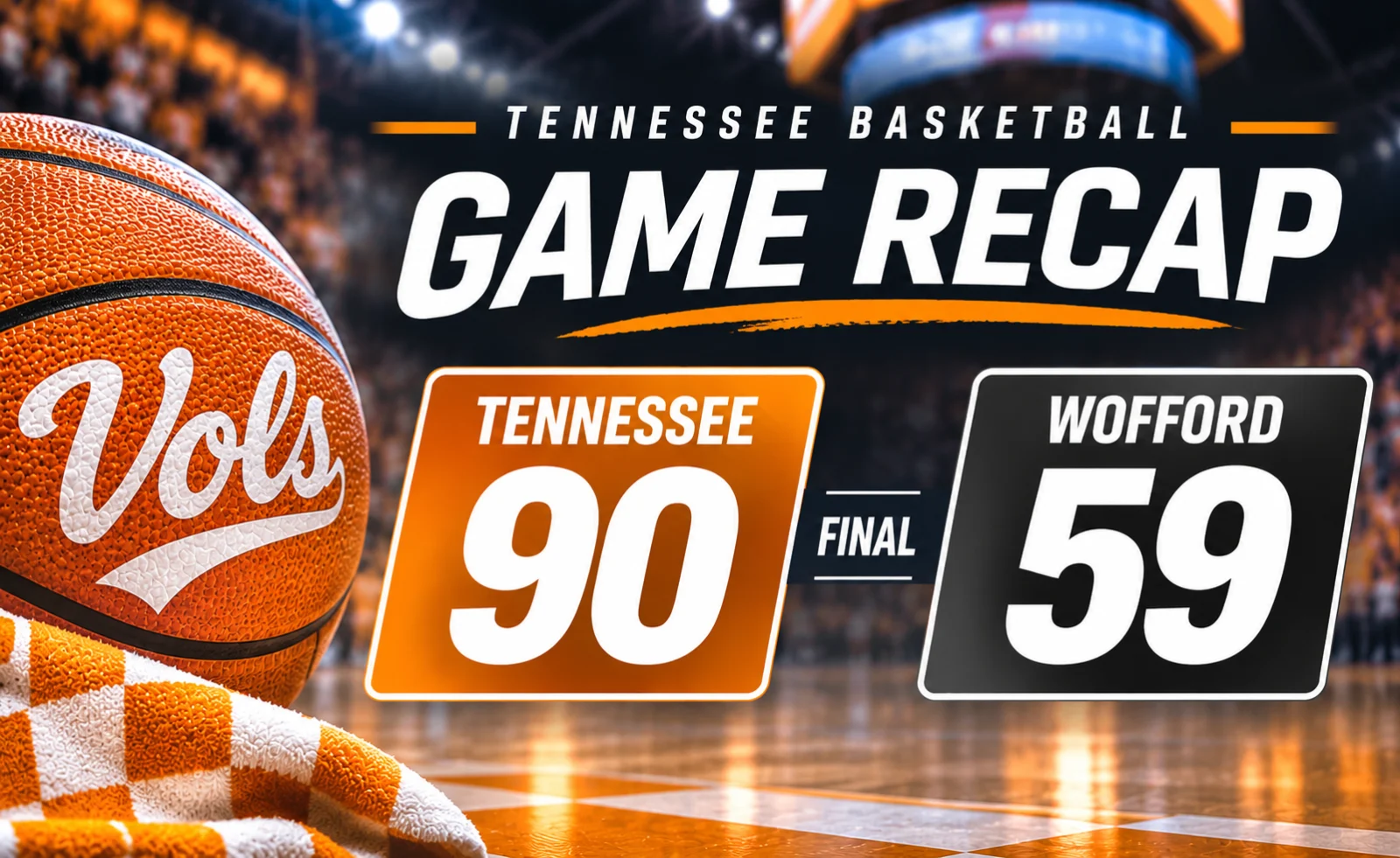
The Volunteers opened their 2026–27 season with a 90–59 victory over Wofford at Food City Center, overcoming a sluggish first half with a considerably more convincing performance after intermission.
It was an encouraging start, particularly for a team whose exhibition performances raised legitimate questions about its readiness for the season.
But the most interesting development wasn’t the 31-point margin of victory. It was the occasional glimpse of how Tennessee’s collection of newcomers and returning players might eventually function as a cohesive unit.
Rick Barnes offered an appropriately measured assessment afterward.
“You saw a glimpse of what they can be. And now it’s about putting it all together.”
That distinction matters.
Tennessee didn’t prove Tuesday night that its chemistry questions have been answered. Wofford, while a respectable and well-coached opponent, isn’t the kind of competition that can provide definitive answers about the Vols’ prospects against the SEC’s best.
Still, there were encouraging signs. And two players in particular gave Tennessee fans plenty to appreciate.
Tyler Lundblade: Four Threes and a Whole Lot of Possibilities
For much of the summer and fall, Tennessee fans have anticipated what Tyler Lundblade’s shooting might mean for an offense loaded with players capable of attacking the basket.
Tuesday offered an early illustration.
Lundblade connected on four of his nine three-point attempts, finishing with 12 points in 22 minutes. Two of those makes came on consecutive possessions early in the game, helping Tennessee establish a 12–6 lead.
But his contribution went beyond the scoring column.
When opponents must account for a dangerous perimeter shooter, the floor effectively becomes larger for everyone else. Defenders are reluctant to leave him, help defense becomes more complicated, and driving lanes that might otherwise be congested begin opening up.
That’s precisely the offensive benefit Tennessee has been hoping Lundblade would provide.
And it isn’t merely an observation from the outside.
Speaking to reporters before the season opener, DeWayne Brown II described the attention Lundblade commands:
“So in some ways, it’s like we’re playing four on four when he’s on the court.”
That’s a revealing assessment from someone who stands to benefit directly from the spacing Lundblade creates.
Against Wofford, Tennessee began showing how that spacing could translate into productive guard play.
Terrence Hill Jr. finished with 17 points despite missing all six of his three-point attempts. Rather than allowing his perimeter struggles to dictate his evening, Hill repeatedly attacked the basket, finding opportunities to score inside and pressure the defense.
Lundblade wasn’t responsible for every opening Hill found, but his presence gives Tennessee an additional weapon for creating those opportunities.
And when the guards began penetrating, moving the ball and playing with greater freedom in the second half, the offense occasionally became downright pretty.
Barnes sees value in Lundblade beyond his shooting.
“He’s an excellent on-the-floor coach,” Barnes said afterward, emphasizing the veteran’s communication, basketball intelligence and leadership.
The coach also praised the calming influence Lundblade has brought to a roster still learning how to play together.
That may prove just as important as his three-point shooting.
Tennessee has plenty of individual talent. What it needs are players who can help that talent function collectively.
Lundblade looks capable of contributing in both ways.
DeWayne Brown II: A Man Among Boys
If Lundblade offered a glimpse of Tennessee’s offensive possibilities, DeWayne Brown II provided something considerably more immediate.
Pure, unmistakable physical dominance.
Brown was a man among boys against Wofford, imposing himself around the basket and on the glass throughout the evening.
The sophomore finished with 17 points and 17 rebounds, establishing career highs in both categories while recording his first collegiate double-double.
He shot 7-for-11 from the floor, grabbed five offensive rebounds and had already secured his double-double with more than 10 minutes remaining.
It was the kind of performance that commands attention, regardless of the opponent.
Wofford coach Kevin Giltner acknowledged the challenge his team faced.
“He’s so physical in every single way.”
Brown’s performance was especially encouraging considering the difficulties he experienced during Tennessee’s exhibition schedule.
Barnes had been looking for more consistent production from the sophomore, particularly as Brown assumes a larger role in the Vols’ frontcourt.
On Tuesday, he delivered.
Barnes called it Brown’s best game by far and praised the work ethic behind the performance.
“I mean, DeWayne puts in more time, works as hard as any player we’ve had here.”
That commitment was evident against the Terriers.
Brown wasn’t simply collecting rebounds that happened to come his way. He battled for position, pursued missed shots and gave Tennessee a powerful interior presence.
His efficiency was equally impressive.
Seventeen points on 11 field-goal attempts is the kind of production that allows an offense to function without requiring its post players to dominate possession after possession.
And there’s an intriguing connection between Brown’s performance and Lundblade’s presence.
If opponents are forced to respect Tennessee’s perimeter shooting, Brown should encounter more opportunities to operate inside. If Brown becomes a consistent threat around the basket, opponents will face difficult decisions about how much defensive attention they can devote to the perimeter.
Against Wofford, Tennessee offered a preliminary look at how those two strengths might complement each other.
The challenge will be reproducing that balance against bigger, stronger and more athletic competition.
A Second Half That Offered Some Encouraging Answers
The first 20 minutes weren’t especially reassuring.
Tennessee led just 34–31 at halftime, struggling to establish consistent offensive rhythm while allowing Wofford to remain within striking distance.
The Vols showed flashes of their talent, but their execution was uneven, and defensive lapses prevented them from creating meaningful separation.
Then came a much different second half.
After Wofford trimmed Tennessee’s advantage to two points, the Vols responded with an 18–2 run over 4:24, stretching their lead to 54–36.
The offense became more aggressive. Defensive stops led to transition opportunities. Players attacked the basket rather than relying so heavily on perimeter shots.
Tennessee ultimately outscored Wofford 56–28 after halftime, shooting 61.1 percent over the final 20 minutes.
For the game, the Vols held a 52–24 advantage in points in the paint and outscored the Terriers 27–6 in fast-break points.
Those numbers were particularly encouraging given Tennessee’s struggles to generate consistent interior offense during exhibition play.
Hill’s willingness to attack the basket was an important part of that improvement.
So was Juke Harris, whom Barnes inserted into the starting lineup for the second half.
Harris finished with seven points and four rebounds, but his impact extended beyond those modest totals. He played with greater freedom, defended more aggressively and finished with a team-best plus-29 rating.
Barnes had encouraged Harris to stop putting so much pressure on himself and simply play basketball.
The response was encouraging.
Troy Henderson added 10 points off the bench, while Miles Rubin contributed eight points, four rebounds and two blocked shots.
Tennessee also committed just three turnovers after halftime, compared with seven in the opening period.
These were meaningful improvements, even if the level of competition requires some restraint in interpreting them.
More Than Halftime Adjustments?
It’s customary to credit a dramatic second-half improvement to halftime adjustments.
And Barnes certainly made changes that contributed to Tennessee’s performance.
But there was something intriguing about the way the Vols began playing together.
The ball moved more purposefully. Guards attacked openings with greater confidence. Defensive stops created opportunities to run. Individual strengths began working in concert rather than appearing as disconnected contributions.
Was that evidence of genuine chemistry beginning to develop?
Perhaps.
It’s too early to know whether Tennessee has established anything lasting, but the second half offered examples of the kind of collective basketball Barnes has been demanding.
The coach acknowledged afterward that the performance gave his staff useful evidence of how the team is capable of playing against outside competition.
That’s important for a roster undergoing such extensive change.
Understanding a system in practice is one thing. Executing it consistently against opponents determined to disrupt it is another.
Tennessee still has considerable work ahead in bridging that gap.
But Tuesday provided some encouraging film for Barnes and his staff to build upon.
Promise, With Perspective
It’s worth remembering where Tennessee stood entering opening night.
The exhibition loss at Duke exposed deficiencies in defensive execution, offensive cohesion and overall readiness. Barnes made no attempt to minimize those problems.
A convincing victory over Wofford doesn’t erase them.
Nor should a strong second half against a Southern Conference opponent be mistaken for proof that Tennessee has discovered a winning formula against the SEC’s elite.
Those tests are still ahead.
What Tuesday provided was something more modest, but nevertheless valuable.
A glimpse of Lundblade’s shooting creating space for Tennessee’s guards.
A glimpse of Brown developing into the physical interior presence the Vols need.
A glimpse of Hill attacking the basket, Harris playing with greater freedom and Tennessee’s defensive effort producing more efficient offense.
Most importantly, a glimpse of how those individual contributions might eventually fit together.
There will be tougher opponents, difficult nights and undoubtedly more growing pains for this new-look roster.
But after an exhibition season that left plenty of questions unanswered, Tennessee’s opening-night performance offered a few encouraging possibilities.
The Vols didn’t prove Tuesday night that they’ve become the team Barnes envisions.
They simply gave us a better idea of what that team might look like.
– Vol Hoops Staff Writer