

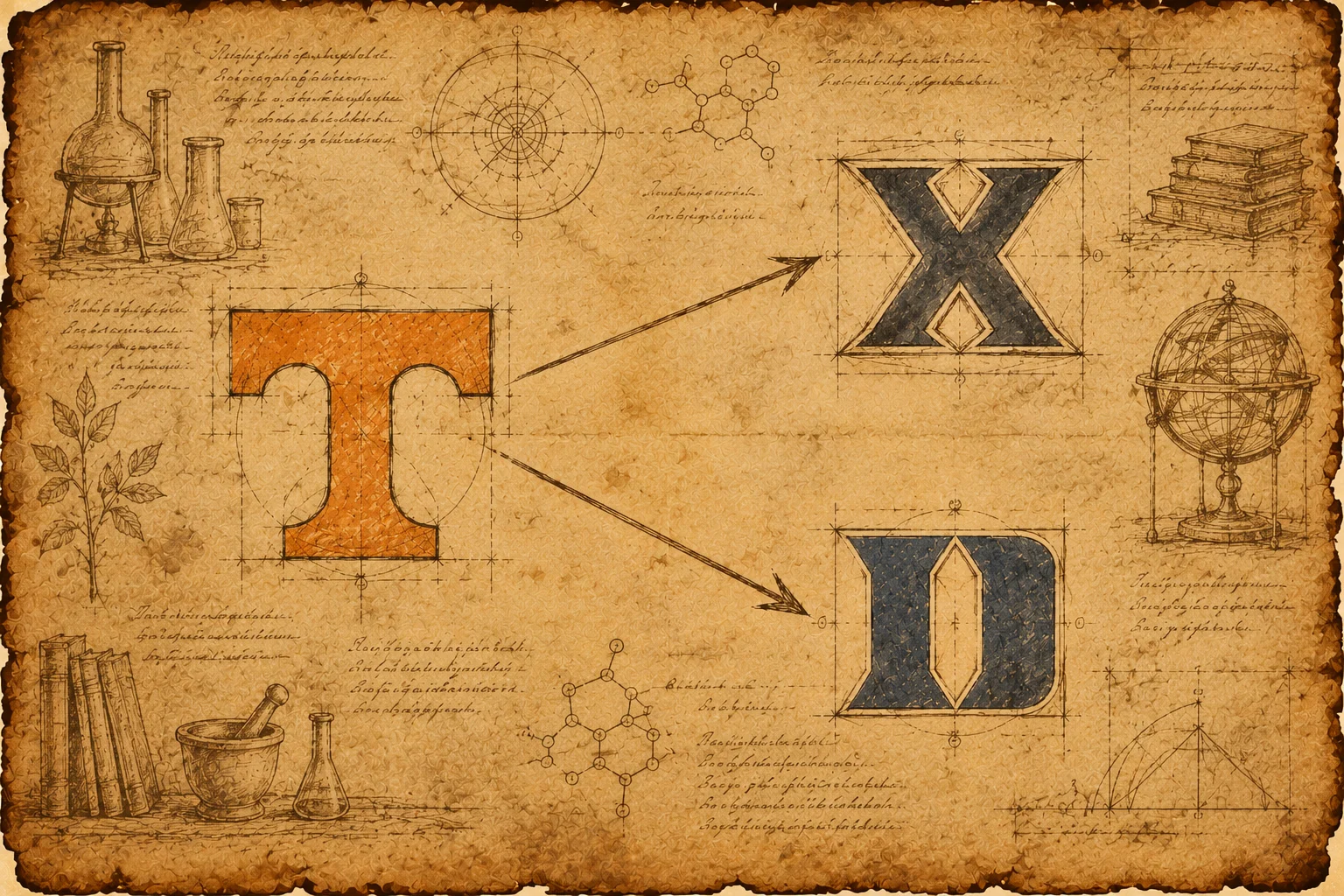
When Tennessee takes the floor against Xavier on Thursday night, the scoreboard will keep track of every basket, foul and turnover. Rick Barnes, meanwhile, will be keeping track of something considerably more important.
Which players belong together?
It’s a question that might take considerably longer than 40 minutes to answer. With nine transfers, four freshmen and only four returning players from last season’s Elite Eight team, Barnes is assembling a basketball team from an unusually large collection of unfamiliar parts.
The talent is there. The experience is there, too, although much of it was acquired elsewhere. What Tennessee doesn’t yet have is a clear picture of how all those pieces will function together against outside competition.
That’s what makes the upcoming exhibitions against Xavier and Duke so valuable. Not the opportunity to collect two meaningless wins, but the chance to discover combinations, expose weaknesses and begin separating what looks promising in practice from what actually works against another team.
Barnes would welcome even more opportunities.
“I wish we had five of them,” he said when discussing exhibition games earlier this fall. “I wish we had some during August.”
For a coach overseeing such a dramatic roster transformation, it’s easy to understand the appeal.
A Rotation That’s Still Taking Shape
Tennessee enters exhibition play with plenty of options and relatively few settled answers.
Terrence Hill Jr., Juke Harris, Dai Dai Ames and Troy Henderson give Barnes an intriguing assortment of backcourt talent. Jalen Haralson brings additional versatility on the wing, while newcomers such as Christian Fermin, Miles Rubin and Braedan Lue provide different possibilities in the frontcourt.
And then there’s Tyler Lundblade, whose recovery from back surgery has delayed his opportunity to establish himself within the rotation.
The challenge isn’t simply determining which players are the most talented. It’s finding the combinations that make Tennessee most effective at both ends of the floor.
Can Barnes play four guards without sacrificing too much rebounding? Which perimeter combinations offer the best balance of scoring, ball movement and defensive pressure? Can a larger lineup generate enough offense without compromising the pace Barnes wants?
Those are questions that can’t be answered by individual statistics alone.
At Tennessee’s October 6 media day, Barnes acknowledged just how unsettled things remain.
“Right now, in terms of a rotation and all that, I really don’t have a clue.”
That’s not necessarily an indictment of the roster. It reflects a coaching staff still evaluating a group that hasn’t enjoyed much time together at full strength.
The exhibitions should help change that.
The Most Revealing Moments Might Not Be the Prettiest
Fans naturally gravitate toward spectacular dunks, deep three-pointers and impressive scoring totals. Those moments are entertaining, and Tennessee certainly has players capable of providing them.
But some of the most useful information for Barnes may come from possessions that never make a highlight reel.
What happens when a lineup struggles to defend a ball screen? How quickly do players communicate when an opponent changes its offensive approach? Who recognizes a mismatch without being directed from the bench? And which combinations can recover from mistakes without allowing one bad possession to become three?
A player might score 18 points and still leave the coaching staff with questions about his defensive assignments. Another might finish with six points but demonstrate the positioning, communication and decision-making that earn him more playing time.
Barnes has made it clear that defensive accountability will remain nonnegotiable.
“We’re going to find a way to guard somebody,” he said at media day.
That determination matters because this roster has been assembled with considerable offensive potential, but its defensive identity remains a work in progress.
The exhibitions offer an opportunity to examine both sides of that equation without the pressure of a regular-season result.
Xavier and Duke Offer Different Opportunities
Thursday’s meeting with Xavier at Food City Center will give Tennessee its first public exhibition opportunity against another program. Five days later, the Vols travel to Duke for another preseason matchup.
Both games should provide useful information, although not necessarily in the same way.
At home against Xavier, Barnes can begin evaluating how different combinations handle outside competition in a familiar environment. The trip to Duke introduces a road setting and another opportunity to observe how players respond when circumstances change.
The opponent matters, of course. Playing capable competition can reveal weaknesses that might remain hidden during an intrasquad scrimmage.
But fans should be careful about drawing sweeping conclusions from either result.
Exhibition rotations can be unconventional. Coaches may give extended minutes to players they want to evaluate, experiment with combinations they wouldn’t normally use in a close regular-season game, or prioritize a specific teaching objective over the immediate result.
A lopsided stretch doesn’t necessarily mean a lineup has failed. Sometimes it simply means the coaching staff has learned something it needed to know.
Likewise, a convincing exhibition victory wouldn’t establish that Tennessee has solved every question facing its new roster.
The value lies in the information gathered.
Finding the Five Who Fit
One of the more intriguing aspects of Tennessee’s roster is that its most productive five individual players may not necessarily form its most effective lineup.
A group loaded with scorers still needs someone willing to defend the opponent’s best perimeter player, fight for rebounds and move the basketball without demanding shots.
A defensively imposing lineup still needs enough offensive versatility to keep opponents honest.
And Barnes must account for the fact that the best combination in November might look very different from the one Tennessee relies upon in February.
That process requires patience, particularly with so many newcomers learning a new system and one another’s tendencies.
The exhibitions won’t provide all the answers. They may even produce a few new questions.
But when Tennessee opens its regular season against Wofford on November 3, Barnes should have a better understanding of which combinations deserve a longer look and which experiments need more work.
Fans will understandably keep an eye on the scoreboard against Xavier and Duke. Winning is always more enjoyable than losing, even when the result doesn’t count.
Just remember that Barnes is conducting a different kind of evaluation.
The most encouraging outcome might not be a victory at all. It might be discovering something about his team that helps Tennessee win when the games finally matter.
– Vol Hoops Staff Writer