

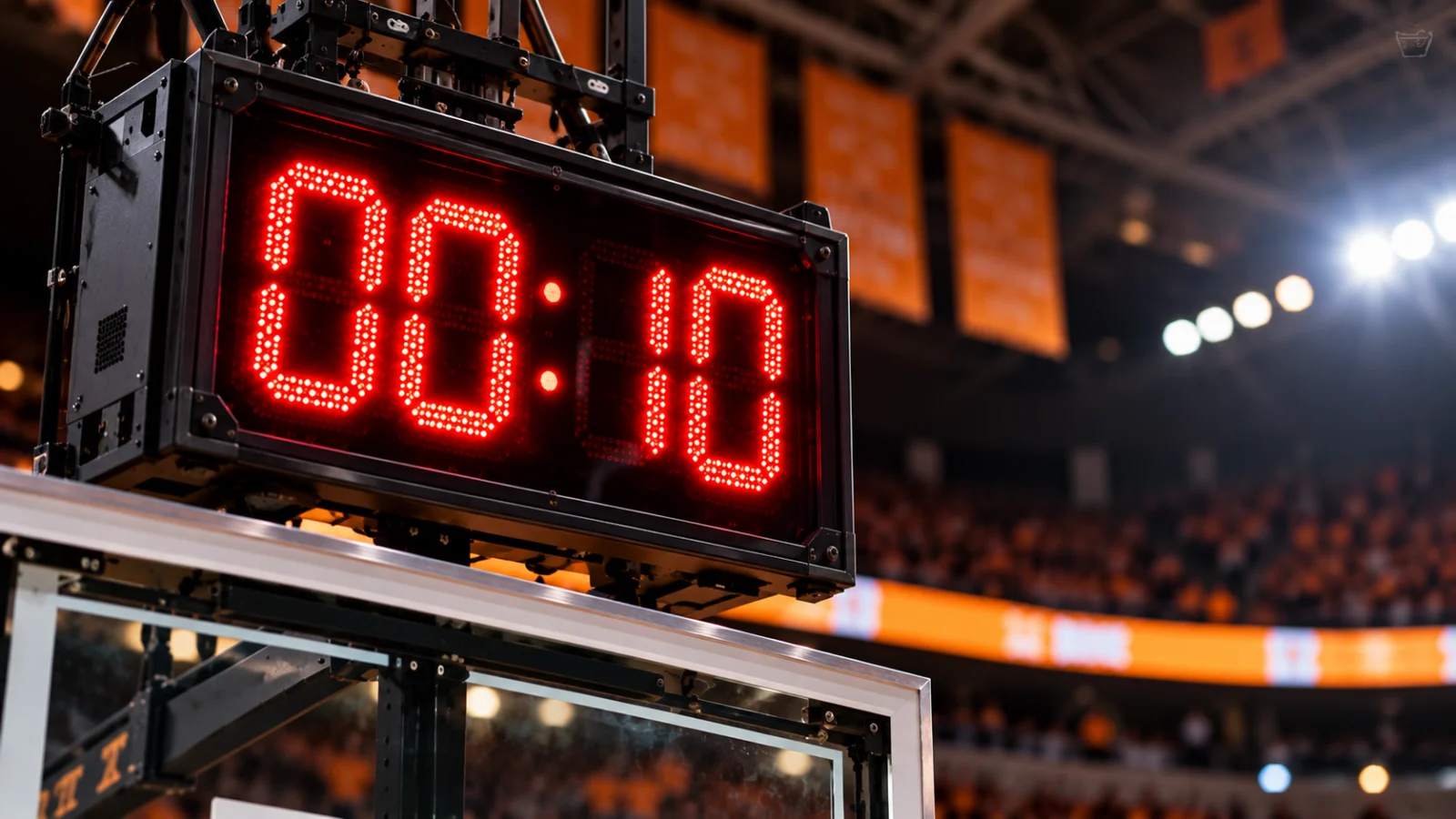
Ten seconds.
That is precisely how long Rick Barnes was giving his players to get something done.
During five-on-five work at the Vols’ first official practice of the preseason, Tennessee frequently operated with the shot clock chopped from the normal 30 seconds all the way down to 10. The purpose was obvious: get up the floor, process what the defense is doing and make a decision. Fast.
It may also be one of our first real clues that this Tennessee team intends to look different.
Barnes has talked about playing faster before. Most coaches do. But Tennessee has finished among the nation’s top 100 in tempo only twice during his tenure and has never finished higher than 80th, according to KenPom data cited by the Knoxville News Sentinel.
This time, Barnes may finally have constructed the roster to actually do it.
“Everybody talks about wanting to run and play in transition,” Barnes said this week, “but very few guys understand how hard that is to do it right.”
That last part matters.
Barnes isn’t trying to turn Tennessee into a team that simply races down the floor and fires the first available shot. Playing fast and playing hurried are two entirely different things.
And this roster offers him options Tennessee hasn’t always had.
Terrence Hill Jr. averaged 15.0 points last season at VCU and Dai Dai Ames averaged 16.9 at Cal. Both can score, but both also give Tennessee experienced ballhandlers capable of creating for somebody else. Juke Harris arrives after averaging 21.4 points at Wake Forest, while Jalen Haralson scored 16.2 per game at Notre Dame.
Then there is Tyler Lundblade, who made 115 three-pointers last season at Belmont. Put shooters and multiple creators around a team willing to attack before a defense gets comfortable, and suddenly the floor can become awfully big.
The interesting part is that Barnes isn’t talking only about offensive speed. He’s tying pace to something he calls “cardio toughness.”
“We’re asking these guys not for a good effort,” Barnes said. “We’re asking them for a max effort every single time.”
That means running when Tennessee has the ball, defending when it doesn’t and being able to do both without execution disappearing when legs get heavy.
It also explains why depth could become such an important piece of the equation. Tennessee’s current roster includes a remarkable collection of experienced transfers and versatile perimeter players, giving Barnes more potential combinations than he’s had in many seasons.
The 10-second clock is essentially the laboratory.
Give the players almost no time, force them to recognize advantages immediately and teach them to remain organized while everything around them is moving faster.
If they can execute in 10, 30 should eventually feel luxurious.
There is an important caution here. It is September. Tennessee hasn’t played an exhibition, much less an SEC game, and Barnes himself isn’t pretending the transformation is complete.
“We’re not there yet,” he said. “We still have a ways to go.”
But that may be what makes the experiment so interesting.
For years, Tennessee basketball under Barnes has built its identity around defense, physicality, discipline and making opponents uncomfortable. None of that appears to be going anywhere.
The question is whether Barnes now has enough scoring, ballhandling, shooting and depth to add something else.
Speed.
Ten seconds at a time, he appears determined to find out.
– Vol Hoops Staff Writer